It’s time to get technical! Welcome to the On Cloud 66 series. This blog series will focus on all things Iridium CloudConnect, showcasing helpful resources and real-life examples of how the service is transforming the satellite-IoT market.
To kick off the series, we wanted to introduce the new Iridium CloudConnect SBD on Amazon Web Services (AWS) Quick Start. For any new Iridium CloudConnect or AWS users, this will be your go-to initial resource. Powered by AWS, Iridium CloudConnect is a satellite cloud-based adapter service that transfers Iridium Short Burst Data® (SBD) messages from Iridium Connected® devices to the AWS Cloud. Since its launch at the end of 2019, numerous Iridium partners have taken advantage of this architecture to bring their next-generation cloud-based solutions to market simply and quickly.
Quick Start is built by AWS solutions architects and partners to simplify the deployment process, helping customers launch popular technologies on AWS quickly, based on AWS best practices for security and high availability. Quick Start reduces hundreds of manual procedures into just a few steps, so you can build your production environment rapidly and start using it immediately.
Each Quick Start includes AWS CloudFormation templates that automate the deployment, and a guide that discusses the architecture and provides step-by-step implementation instructions.
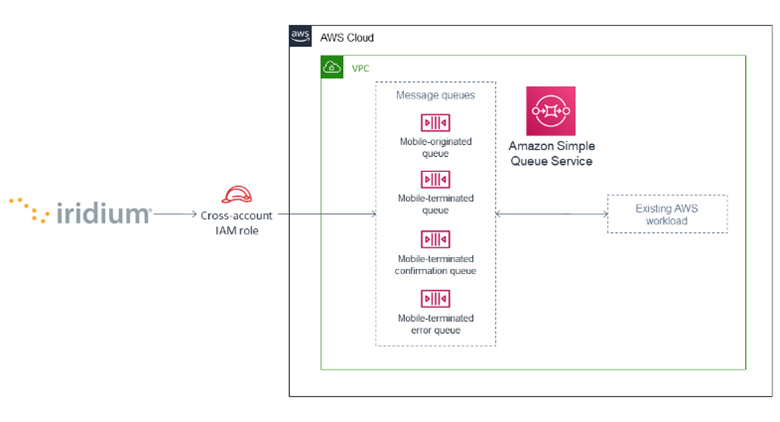
The Iridium CloudConnect SBD on AWS Quick Start deploys Iridium CloudConnect into an existing AWS account. Using Amazon Simple Queue Service (Amazon SQS), this deployment establishes the standard architecture to get SBD messages to and from devices on the Iridium network into the AWS Cloud.
What does the Quick Start do?
It deploys Amazon SQS into your existing virtual private cloud (VPC).
It then configures queues for Mobile-originated, Mobile-terminated, Mobile-terminated confirmation, Mobile-terminated error.
It creates an AWS Identity and Access Management (IAM) role and policy for Iridium CloudConnect cross-account authentication. You can send and receive messages through the QSQ queues.
Messages can be viewed in the SQS console or by using some of the Amazon SDKs or Amazon community developed tools.
Stay tuned for our next post in the On Cloud 66 series where we will dive deep into Iridium CloudConnect, reviewing how it works, what it does and how it is helping extend the reach of IoT technologies to 100 percent of the planet through satellite connectivity.
Iridium and our partner Thales are proud to be the official communications partner of IMOCA (International Monohull Open Class Association). IMOCA racing yachts are equipped with the Thales VesseLINK™ 700 L-band broadband terminal powered by Iridium Certus®, enabling high-speed global connectivity for skippers anywhere they sail.
Many IMOCA skippers are currently participating in the Vendée Globe – the single-handed, non-stop round-the-world yacht race that happens every four years. Since early November 2020, skippers have sailed over 28,000 nautical miles through some of the world’s most treacherous oceans and are sailing towards the finish line in Les Sables d’Olonne, France.
Iridium is the only satellite network with reliable, truly global connectivity, regardless of weather conditions, which is why IMOCA skippers rely on the Iridium Certus Thales VesseLINK terminal to stay connected while they compete. Iridium Certus® enables IMOCA skippers to easily communicate with their shore teams, send photos and texts to friends and family, conduct interviews over Skype, and in the most extreme cases, get rescued.
Connectivity at sea became a lifeline for skipper Kevin Escoffier, who had to trigger his distress beacon and contact his team for help after his boat endured extreme damage caused by inclement weather a few weeks into the Vendée Globe. Following the successful rescue, President Emmanuel Macron of France checked in with Kevin and competitor Jean Le Cam, who made the rescue, in a call over the Iridium network.
Skipper Samantha Davies utilizes the connectivity provided at sea to keep in touch with family and to help promote her charity and boat namesake, Initiatives-Coeur. “It is thanks to [Iridium connectivity] that the public will be able to follow me, and we will be able to get a great interaction to raise as much money as possible for the charity, she shares.”
“During an intense race like the Vendee Globe, so many things are out of a skipper’s control,” says Bryan Hartin, Executive Vice President, Sales and Marketing. “Iridium connectivity plays a vital role in ensuring IMOCA skippers have reliable connectivity to stay safe and in touch, as they race around the world’s oceans.”
As the 2020-2021 Vendée Globe nears its end, IMOCA skippers are giving it their all as they race to the finish line. The skippers continue to share updates from the ocean on Twitter using the hashtags #VG2020 and #VendeeGlobe and on the IMOCA and the Vendée Globe accounts. You can also follow the race in real time by tracking the skippers progress on the race tracker, and catch updates, news, and video clips on the IMOCA website.
Exclusive Iridium partner MetOcean Telematics has been awarded a five-year blanket purchase agreement (BPA) to supply the United States Coast Guard (USCG) with its Search and Rescue (SAR) buoy, the Iridium Self Locating Datum Marker Buoy (iSLDMB™). A critical tool for SAR events, the innovative, rugged, and compact buoy is designed and tested to meet the stringent performance requirements of coast guards around the world.
The iSLDMB plays a useful role in adding additional safety and protection for USCG personnel. During an active SAR event, USCG aircraft can quickly deploy the buoys across the vast ocean territory to their targeted location by air. When the buoy hits the water, its suite of sensors monitor the first meter below sea level of the surrounding area and can detect objects, surface temperature, and provide critical real-time lifesaving data over the Iridium® satellite network. This helps to cover and monitor vast territories more quickly and can help to significantly reduce overall search time, and as a result, aid in saving lives at sea.
The cost-effective and reliable SAR buoy has supported coast guards around the world and is also utilized by navies, oceanographic institutes, environmental agencies, and oil and gas companies. A core-user of the iSLDMB, the USCG has already experienced first-hand the numerous operational advantages of this SAR buoy and will continue to utilize the technology to assist in saving lives.
“During situations that require Search and Rescue, every second counts,” says Iridium Executive Vice President of Sales and Marketing, Bryan Hartin. “The unique ability for the iSLDMB to communicate critical data in real-time to the end user from any of the patrolled oceans will continue playing a critical role in supporting the United States Coast Guard efforts.”
Communicating while on-the-go, especially texting, is woven into the fabric of our society. For many people it’s their preferred method of communication, so when life takes them to places where cellular coverage is unreliable or even unavailable, frustration and sometimes panic ensues. But why and how, in 2021, are there still places without coverage? And more importantly, how do you send a text when outside of cellular range?
It may come as a surprise, but many popular locations across the country lack cell coverage. For instance, imagine you’re on a scenic hike in one of the United States’ many national parks and stop to take a picture. You’re proud of your amateur photographer skills and want to send it to your friends and family, but when you hit the send button you realize you’re outside of cell coverage (UGH!). This frustrating communications gap exists because ground infrastructure, like cell towers, have inherent limitations – they can only provide coverage as far as their signal can reach and can’t be built everywhere, due to laws, safety concerns and cost restrictions. In the case of America’s national parks, environmental preservation is the main reason there are no cell towers, thus making phone calls and sending texts impossible. So, you may be wondering, is there a solution?
If you are venturing to remote locations, satellite technology, such as satellite phones or personal communications devices, are your answer to stay connected. Think of Iridium’s satellites as your dedicated cell towers in the sky. In orbit around the earth, they do not have the same limitations as ground infrastructure, making it possible to deliver ubiquitous and reliable coverage across the entire planet. For mobile, on-the-go communications like placing phone calls and sending text messages, the Iridium® network is unmatched. Located in Low Earth Orbit (LEO) and comprised of 66 crosslinked satellites, it is the only network capable of delivering reliable, truly global connectivity. As long as you have a view of the sky, your Iridium Connected® device can help you speak, text, email or even send pictures from virtually anywhere.
If all you really need or want is the ability to send text messages, Iridium Connected personal communication devices that connect to your smartphone with satellite technology are your answer. For instance, products and companies including the Garmin InReach, ZOLEO, GSAT Micro, Somewear, RockSTAR, Solara Flare, HoneywellGMPT-401, Bivystick, and NAL Shout offer a variety of affordable satellite options, each with a suite of features that can transform your smartphone into a personal satellite device. In addition to adding satellite connectivity to your cellular device, many offer an emergency response component in the form of an SOS button so you can easily call for help when the unpredictable happens.
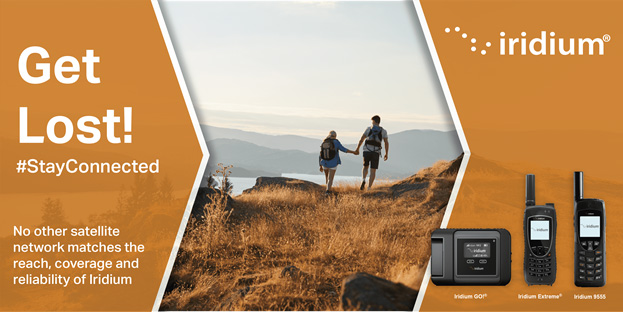
Another option, the Iridium GO!®, brings the flexibility to text when you want to, but also make phone calls when needed. Plus, you can simultaneously link up to five smart devices and remain connected up to 100 feet from the device. For our fellow campers out there, gone are the days of being trapped inside your tent during a rainstorm, unable to communicate with the outside world. With the Iridium GO!, you can keep it outside while you’re covered inside and still text, call and send pictures from anywhere in the world.
For the chattier adventurers out there, Iridium’s satellite phones offer a ruggedized, lightweight, easy-to-use experience. Equipped with market-leading features like GPS-enabled location awareness, global voice calling and text messaging solutions for your smartphone, e-mail messaging capabilities and Google Mapping services, the Iridium Extreme® is the ultimate gadget. It is also equipped with an SOS button to quickly contact emergency responders, providing accurate location data to support rescue efforts.
So, the next time you are preparing for an adventure, whether it’s a camping trip, a long cross-country drive or a sailing voyage, make sure to include an Iridium Connected satellite device on your packing list. For more information about Iridium’s products and solutions, please visit www.iridium.com
You are currently browsing the Iridium UAT blog archives for January, 2021.